Star Trek: United Kingdom – The Last Bastion (AU/AI Lore | 1940–2402)

Fiction stories and articles written by members.
Lordroel
Posts: 1401
Joined: Thu Nov 17, 2022 10:49 am
Contact:

Re: Star Trek: United Kingdom – The Last Bastion (AU/AI Lore | 1940–2402)

Post by Lordroel »

Okay, something that is my own creation with the help of AI.

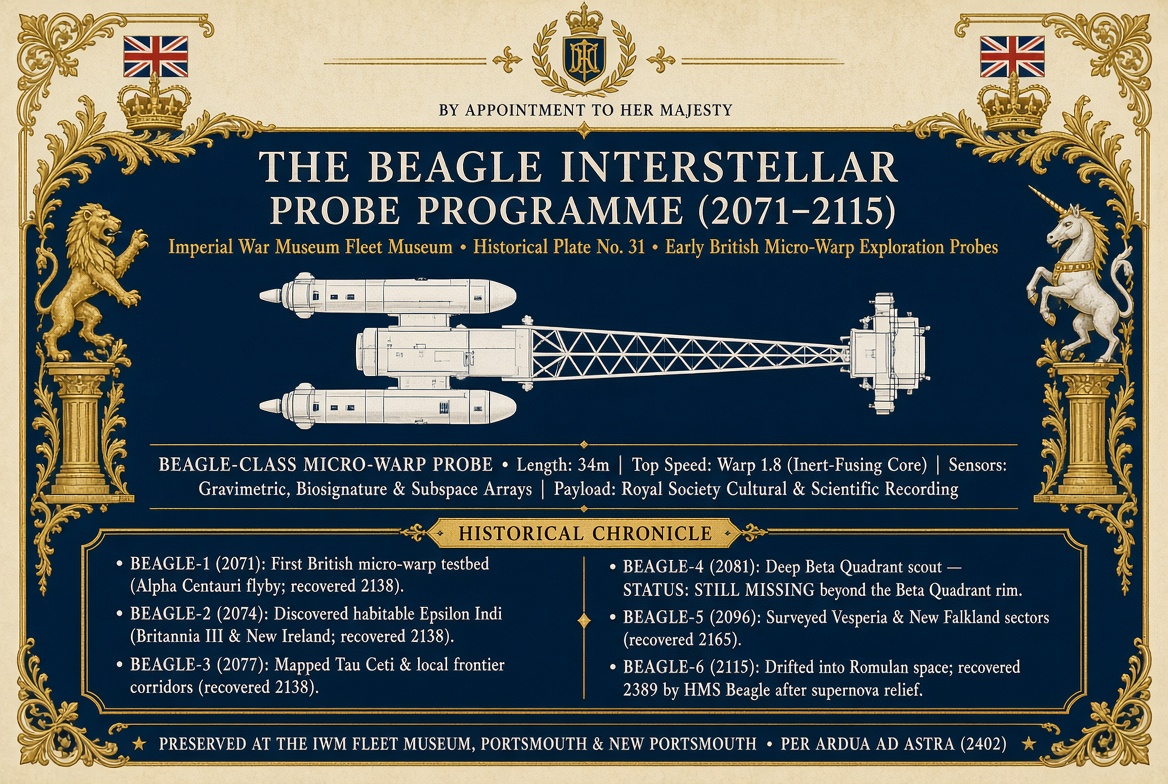
Imperial War Museum Fleet Museum Plate No. 31 — The Beagle Interstellar Probe Programme (2071–2115)

Image

Institution: Imperial War Museum (IWM) Fleet Museum (HMNB Portsmouth & HMNB New Portsmouth)

Spacecraft Class: Beagle-Class Early Micro-Warp Exploration Probe (6 Built • 34m Length)
Propulsion & Top Speed: Early Safe Inert-Fusing Micro-Warp Core (Warp 1.8 Maximum Sustained Speed)
Sensors & Scientific Instruments: Long forward lattice truss boom isolating gravimetric scanners, atmospheric/biosignature spectrometers, magnetometer arrays, and high-gain subspace telemetry transceivers from rear warp-field interference
Cultural Payload: Royal Society Cultural & Scientific Archive (carrying peaceful greetings from King George VII, planetary science records, works of Shakespeare, Newton, and Darwin, and Elgar's Nimrod)
Motto: "Per Ardua ad Astra" (Through Adversity to the Stars)

Architecture & Historical Significance:

Launched in the aftermath of World War III and Britain's rapid orbital recovery, the six unmanned Beagle probes (Beagle-1 through Beagle-6) were the United Kingdom's first interstellar pathfinders. Designed around a compact central reactor disc, twin rear micro-warp nacelles, and an extended forward lattice truss boom that kept sensitive biosignature and gravimetric instruments clear of early warp-field radiation, each 34-metre probe carried a shielded Royal Society Cultural & Scientific Archive outward into uncharted space.

Mission Roster & Fates (2071–2389):

• Beagle-1 (Launched 2071): First British micro-warp interstellar testbed (Sol perimeter & Alpha Centauri flyby); retrieved in 2138 and preserved at the IWM Fleet Museum.

• Beagle-2 (Launched 2074): First detected the habitable Epsilon Indi system (Britannia III and Britannia IV / New Ireland), directly sparking British interstellar colonization; retrieved in 2138 alongside Beagle-1 and Beagle-3.

• Beagle-3 (Launched 2077): Charted the Tau Ceti and local Alpha Quadrant corridors; retrieved in 2138.

• Beagle-4 (Launched 2081): Deep-range Beta Quadrant scout; Status: Still Missing beyond the Beta Quadrant rim (remaining a priority search objective for RSF survey cruisers in 2402).

• Beagle-5 (Launched 2096): Surveyed the Vesperia and New Falkland frontier sectors; decommissioned and recovered in 2165.

• Beagle-6 (Launched 2115): Drifted across the future Romulan border during the early 22nd century. Following the 2387 Romulan supernova and Britain's major humanitarian relief effort for Romulan refugees, survey cruiser HMS Beagle received diplomatic clearance in 2389 to recover Beagle-6 from an abandoned Romulan border archive—reuniting it with Beagle-1, 2, 3, and 5 at the IWM Fleet Museum.
Lordroel
Posts: 1401
Joined: Thu Nov 17, 2022 10:49 am
Contact:

Re: Star Trek: United Kingdom – The Last Bastion (AU/AI Lore | 1940–2402)

Post by Lordroel »

Halcyon-Class (DY-430B) Survey & Research Ships (2064–2095)

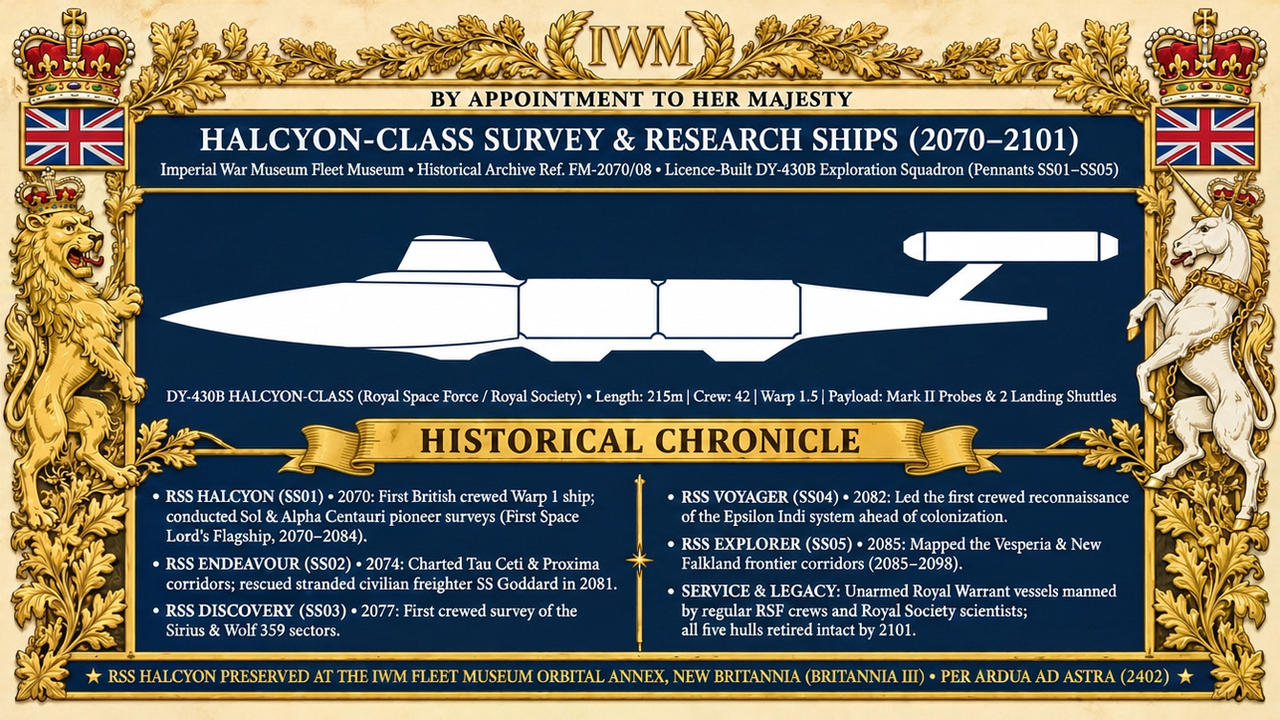
Imperial War Museum Fleet Museum Archive Ref. FM-2070/08 — Halcyon-Class (DY-430B) Survey & Research Ships (2070–2101)
Institution:

Image

Imperial War Museum (IWM) Fleet Museum (Orbital Annex above New Britannia [Britannia III], HMNB Portsmouth & HMNB New Portsmouth)
Spacecraft Class: Halcyon-Class (DY-430B Licence-Built BAE Systems Space & Orbital / Rolls-Royce Subspace & Warp Systems) (5 Unarmed Royal Warrant Survey Vessels • Pennants SS01–SS05 • 215m Length • 42 Crew)
Operating Service: Owned by the Admiralty and manned directly by regular Royal Space Force (RSF) officers, ratings, and embarked Royal Society scientists (decades prior to the formation of the Royal Space Auxiliary for colonial logistics)
Propulsion & Top Speed: Rolls-Royce Subspace & Warp Systems Safe Inert-Fusing Micro-Warp Core (Warp 1.5 Maximum Sustained Speed)
Sensors, Probes & Landing Craft: Windowless armored submarine-style conning tower (internal sensor viewscreens), modular Royal Society astrometrics pods, single forward probe launcher deploying Mark II-A (Sensor), Mark II-B (Atmospheric), and Mark II-C (Survey) probes (evolved from the 2064–2070 Sol-system Mark I testbed), and a ventral shuttle bay housing two heat-shielded atmospheric landing shuttles
Motto: "Per Ardua ad Astra" (Through Adversity to the Stars)

Royal Research Ship (RSS) Warrant & Orbital Assembly (DY-400/430 → DY-430B):

Modeled directly on the United Kingdom's historic Royal Research Ship (RRS) tradition—where unarmed scientific exploration vessels hold a Sovereign's Royal Warrant—the five Halcyon-class pioneers operated under the RSS (Royal Research Ship) prefix (SS01–SS05). Following seven years of post-First Contact engineering, BAE Systems Space & Orbital and Rolls-Royce Subspace & Warp Systems acquired a manufacturing licence for the proven DY-400/DY-430 interplanetary hull, boosting modular sections into space from Woomera and Ascension Island for final assembly in Low Earth Orbit (LEO).

Squadron Roster (2070–2101):

• RSS Halcyon (SS01) • 2070: Britain's first crewed Warp 1 ship; served as First Space Lord's Flagship (2070–2084) and conducted pioneering Sol-perimeter and Alpha Centauri surveys (preserved intact at the IWM Fleet Museum Orbital Annex above New Britannia [Britannia III]).
• RSS Endeavour (SS02) • 2074: Charted the Tau Ceti and Proxima corridors; rescued the stranded civilian freighter SS Goddard in 2081.
• RSS Discovery (SS03) • 2077: Completed the first crewed astronomical and planetary surveys of the Sirius and Wolf 359 sectors.
• RSS Voyager (SS04) • 2082: Following Beagle-2's initial probe telemetry, led the first crewed reconnaissance and shuttle landing surveys of Epsilon Indi (Britannia III and Britannia IV / New Ireland), directly enabling the First-Wave Colony Arks.
• RSS Explorer (SS05) • 2085: Mapped the outer Vesperia and New Falkland frontier sectors (2085–2098).

Type 25 Vanguard-Class Warp 6 Battlecruisers (2155–2185)

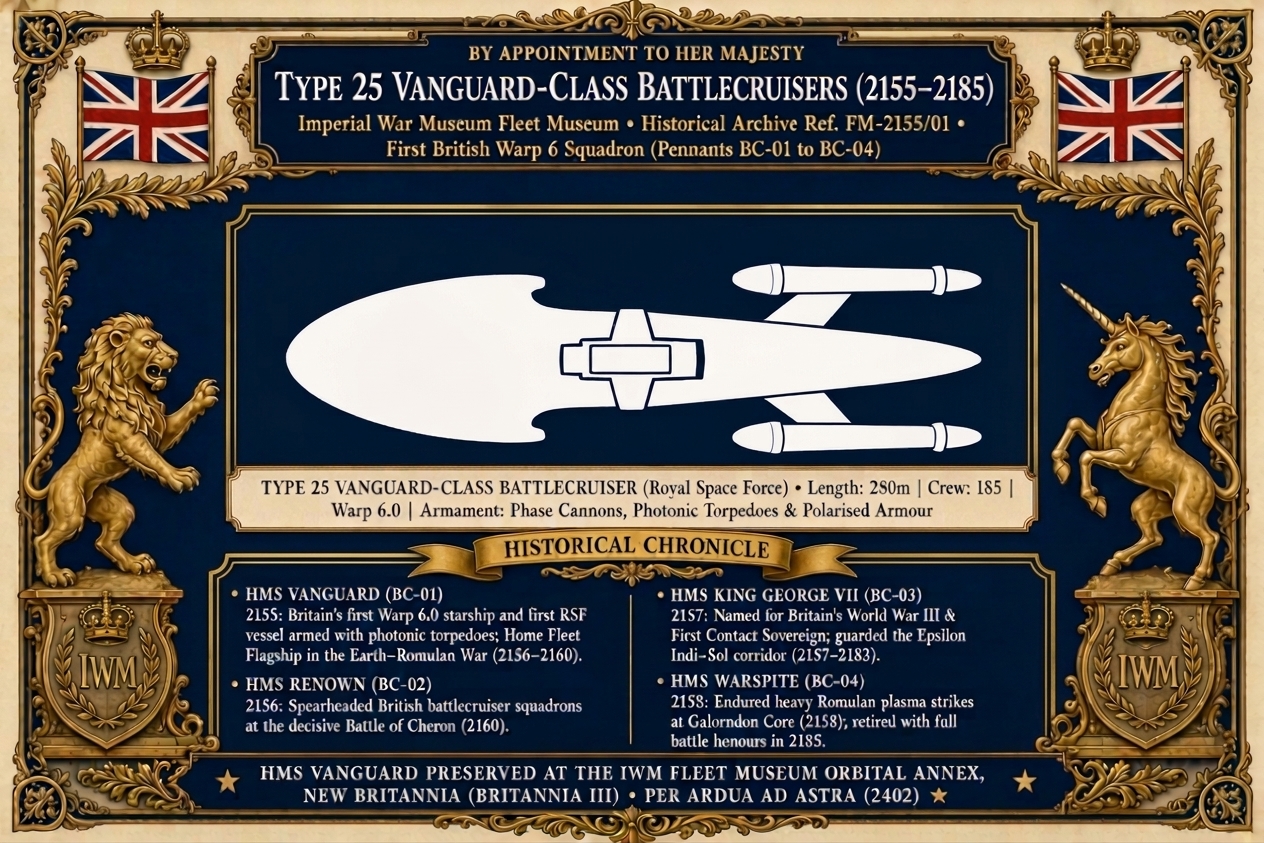
Imperial War Museum Fleet Museum Archive Ref. FM-2155/01 — Type 25 Vanguard-Class Warp 6 Battlecruisers (2155–2185)
Image

Institution: Imperial War Museum (IWM) Fleet Museum (Orbital Annex above New Britannia [Britannia III], HMNB Portsmouth & HMNB New Portsmouth)
Spacecraft Class: Type 25 Vanguard-Class Battlecruiser (BAE Systems Space & Orbital / Rolls-Royce Subspace & Warp Systems) (4 Commissioned Battlecruisers • Pennants BC-01 to BC-04 • 280m Length • 185 Crew — Inaugurating the RSF battlecruiser lineage leading through the Type 50, Type 75, and Type 90 classes to 2402's Type 100 Lion-Class)
Propulsion & Top Speed: Rolls-Royce Subspace & Warp Systems Merlin-W6 Matter/Antimatter Core (Warp 6.0 Maximum Sustained Speed)
Armament & Protection: 6 Retractable Dual Phase-Cannon Turrets, Twin 2×2 Forward Photonic Torpedo Launchers (4 forward tubes — first RSF warship class armed with variable-yield photonic torpedoes, replacing older spatial torpedoes), 2 Aft Torpedo Tubes, and Polarised Duranium-Tritanium Hull Armour
Motto: "Per Ardua ad Astra" (Through Adversity to the Stars)

A Uniquely British Starfleet Silhouette (2155):

Designed in the early 2150s as a deliberate departure from United Earth Starfleet's detached-saucer NX-class layout, the Type 25 Vanguard-class established the classic Royal Space Force warship profile—merging a broad, rounded forward bow (housing twin 2×2 photonic torpedo launchers) continuously into a straight-flanked Royal Navy central engineering hull topped by an armored Admiralty bridge citadel and twin rear Rolls-Royce warp nacelles. Built at New Cornwall's Lunar Drydocks and L5 Orbital Yards, the four battlecruisers served across thirty years of front-line war and frontier patrol (2155–2185).

Squadron Roster (2155–2185):

• HMS Vanguard (BC-01) • 2155: Britain's first Warp 6.0 starship and first RSF vessel armed with photonic torpedoes; served as RSF Home Fleet Flagship during the Earth–Romulan War (2156–2160) (preserved intact at the IWM Fleet Museum Orbital Annex above New Britannia [Britannia III]).
• HMS Renown (BC-02) • 2156: Spearheaded British battlecruiser squadrons alongside Starfleet and Vulcan allies at the decisive Battle of Cheron (2160).
• HMS King George VII (BC-03) • 2157: Named in honour of Britain's World War III & First Contact Sovereign; guarded the Epsilon Indi–Sol corridor (2157–2183).
• HMS Warspite (BC-04) • 2158: Endured heavy Romulan plasma strikes at Galorndon Core (2158); retired with full battle honours in 2185 as second-generation Type 50 battlecruisers entered service.
Lordroel
Posts: 1401
Joined: Thu Nov 17, 2022 10:49 am
Contact:

Re: Star Trek: United Kingdom – The Last Bastion (AU/AI Lore | 1940–2402)

Post by Lordroel »

Last one for today, the Dominion War RSF Orbat is still work in progress, if anybody still is inserted in the timeline.

Imperial War Museum Fleet Museum Archive Ref. FM-2156/ORBAT — Royal Space Force Order of Battle: Earth–Romulan War (2156–2160)

Image

Admiralty Campaign Designation: First Romulan Conflict (Coalition Defence Campaign, 2156–2160)
Wartime Commander: Admiral Sir Richard Jellicoe (Commander, Royal Space Force Expeditionary Forces, 2157–2160)
Compiled By: Royal Space Force Historical Branch (RSFHB) & National Museum of the Royal Space Force (NMRSF) for the Imperial War Museum (IWM) Fleet Museum
Active Wartime Strength (2156): 44 Commissioned Front-Line Warships + 12 Royal Space Auxiliary Fleet Oilers & Troopships
Official RSF Battle Honours: CHERON 2160 • GALORNDON CORE 2158 • EPSILON INDI CONVOYS 2156–2160
Motto: "Per Ardua ad Astra" (Through Adversity to the Stars)

Coalition Service & Wartime Deployment (2156–2160):

When the Romulan Star Empire launched surprise nuclear and plasma attacks across human space in 2156, Britain honoured its Coalition of Planets commitments—fighting what Admiralty archives officially designate as the First Romulan Conflict (Coalition Defence Campaign)—alongside United Earth Starfleet, Vulcan, Andoria, and Tellar. Commanded by Admiral Sir Richard Jellicoe, the RSF fielded a compact, battle-hardened expeditionary fleet of 44 warships divided between Task Force 1 (Home & Sol Defense Squadron) and Task Force 2 (Epsilon Indi Expeditionary Force). While Starfleet carried the wider deep-space offensive, RSF cruisers and escorts bore heavy losses (★) defending Britannia III—Britain's principal extrasolar colony founded during the early warp expansion era—and its vital 11.8-light-year Sol–Britannia III convoy lifeline, while Britain's four Type 25 Vanguard-class battlecruisers (armed with Mark III Tigerfish variable-yield photonic torpedoes) spearheaded decisive fleet actions at Galorndon Core (2158) and the Battle of Cheron (2160).

Summary of Wartime Formations:

• Task Force 1 — Home & Sol Defense Squadron (New Cornwall & Port Elizabeth L5): 3 Type 25 Battlecruisers (HMS Vanguard BC-01, HMS Renown BC-02, HMS Warspite BC-04), 4 County-Class Heavy Cruisers (HMS Yorkshire, HMS Kent, HMS London, HMS Devonshire ★), 6 Daring-Class Destroyers (1 lost ★), and 8 Blackwood-Class Patrol Frigates (1 lost ★).

• Task Force 2 — Epsilon Indi Expeditionary Force (New Portsmouth, Britannia III): 1 Type 25 Battlecruiser (HMS King George VII BC-03), 4 County-Class Heavy Cruisers (HMS Cornwall, HMS Suffolk, HMS Norfolk ★, HMS Dorsetshire), 8 Daring-Class Escort Destroyers (2 lost ★), and 10 Blackwood-Class Patrol Frigates (1 lost ★).
Lordroel
Posts: 1401
Joined: Thu Nov 17, 2022 10:49 am
Contact:

Re: Star Trek: United Kingdom – The Last Bastion (AU/AI Lore | 1940–2402)

Post by Lordroel »

Royal Space Force Roll of Honour: The Dominion War (2373–2375)

Image

Imperial War Museum Fleet Museum Archive Ref. FM-2375/ROLL — Royal Space Force Roll of Honour: The Dominion War (2373–2375)

Compiled By: Royal Space Force Historical Branch (RSFHB) & National Museum of the Royal Space Force (NMRSF) for the Imperial War Museum (IWM) Fleet Museum
Total Vessels Lost in Action (2373–2375): 48 Vessels (39 Commissioned RSF Warships + 9 Royal Space Auxiliary & Planetary Assault Landship Transports)
Official RSF Battle Honours: TYRA 2373 • OPERATION RETURN 2374 • HELASPONT NEBULA 2374 • BETAZED 2374 • CHIN'TOKA 2374 • CARDASSIA 2375
Motto: "Per Ardua ad Astra" (Through Adversity to the Stars)

Wartime Mobilization, the RSFRF & The Dominion War (2373–2375):

Entering the Dominion War in 2373 alongside its four active Queen Anne II-class light fleet carriers (HMS Queen Anne II, HMS Invincible, HMS Indomitable, and HMS Eagle) and Batch I/II squadrons of Type 100, Type 82, Type 45, Type 43 New Battle, Type 23 Castle, and Type 21 Leopard warships, the Admiralty reactivated 32 older hulls from orbital holding in the Royal Space Force Reserve Fleet (RSFRF — Britain's orbital mothball reserve at Port Elizabeth, L5): 12 Mount-class heavy cruisers (named after the highest peaks of Great Britain and New Britannia, led by HMS Ben Nevis) and 20 Type 22 Boxer-class frigates, while orbital yards launched an emergency Batch II/III wartime surge (including Type 100 battlecruisers HMS Hood BC-104 and HMS Repulse BC-105).

Across three years of brutal combat—including Operation Return (2374, where heavy cruiser HMS York was lost), Chin'toka (2374, where light carrier HMS Eagle was lost), and the catastrophic 2374 Helaspont Nebula Ambush (Operation Drake, where 8 RSF warships including battlecruiser HMS Repulse BC-105 and 3,412 personnel were lost before survivors led by HMS Belfast broke out)—Britain lost 48 vessels (39 RSF warships + 9 RSA/PAL troop and cargo transports, with zero principal 2402 RSA or Albion-class hulls lost). Following the 2376 Chilcot-Repulse Inquiry and 2380 Naval Modernization Act, surviving RSFRF Mount/Boxer hulls, Type 43 destroyers, and Type 23/21 frigates were retired (2378–2395) in favor of the new Type 26 City and Type 31 Inspiration classes, while the three surviving Queen Anne II-class light carriers were replaced in 2390 by the two 580m Type 90 Ark Royal-class fleet carriers (HMS Ark Royal and HMS Illustrious).

Summary of Roll of Honour (48 Vessels Lost ★):

• Capital & Cruiser Units (15 Warships Lost): 1 Type 100 Battlecruiser (HMS Repulse BC-105 ★), 1 Queen Anne II-Class Light Carrier (HMS Eagle CVL-84 ★), 4 Type 82 Heavy Cruisers (HMS York ★, HMS Sheffield ★, HMS Coventry ★, HMS Exeter ★), 2 Explorer-Class Survey Cruisers (HMS Endurance ★, HMS Terra Nova ★), and 7 reactivated RSFRF Mount-Class Heavy Cruisers (HMS Ben Nevis ★, HMS Snowdon ★, HMS Scafell Pike ★, HMS Slieve Donard ★, HMS Mount Sovereign ★, HMS Mount Albion ★, HMS Cairngorm ★).
• Escort, Recon & Auxiliary Units (24 Warships & 9 RSA/PAL Transports Lost): 2 Type 45 Daring-Class Destroyers (HMS Defender ★, HMS Diamond ★), 3 Type 43 New Battle-Class Destroyers (HMS Trafalgar ★, HMS Jutland ★, HMS Waterloo ★), 4 Type 23 Castle-Class Frigates (HMS Bamburgh ★, HMS Tintagel ★, HMS Kenilworth ★, HMS Alnwick ★), 2 Type 21 Leopard-Class Frigates (HMS Leopard ★, HMS Jaguar ★), 1 Type 12 Sloop (HMS Hermione ★), 1 River LPC (HMS Tyne ★), 11 reactivated RSFRF Type 22 Boxer-Class Frigates ★, and 9 wartime RSA/PAL logistics and troop transports ★.
Post Reply