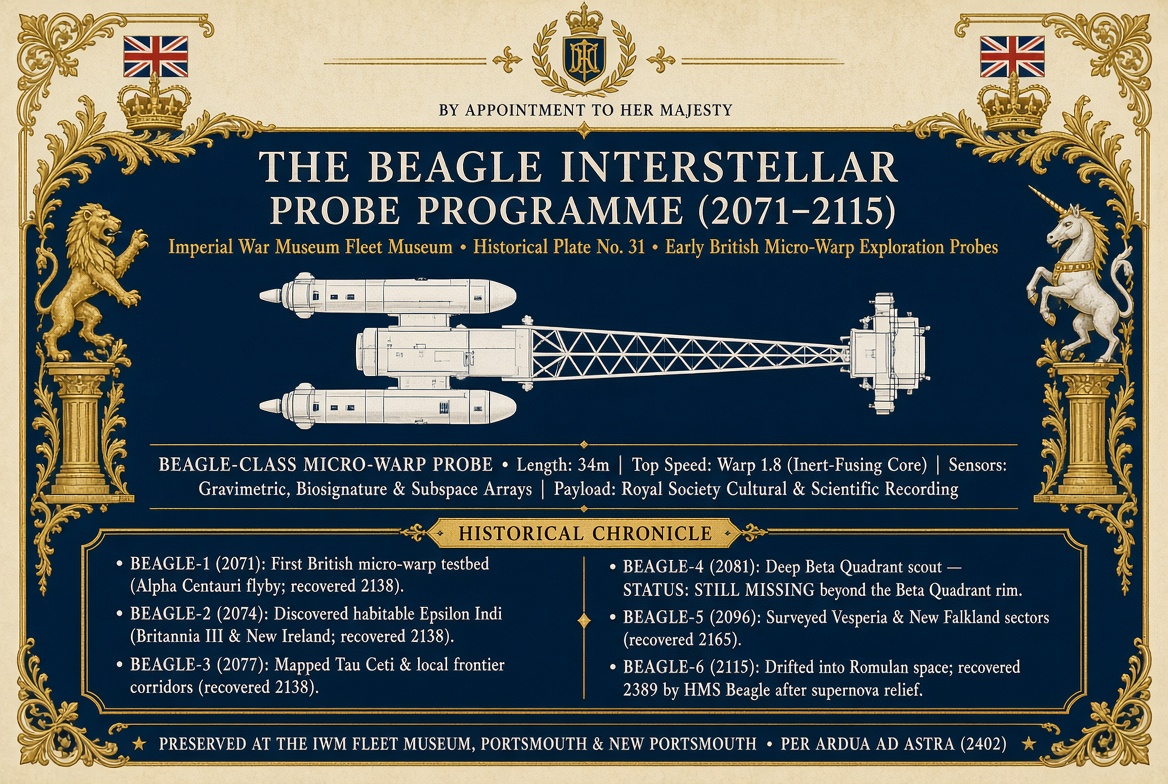
Halcyon-Class (DY-430B) Survey & Research Ships (2064–2095)
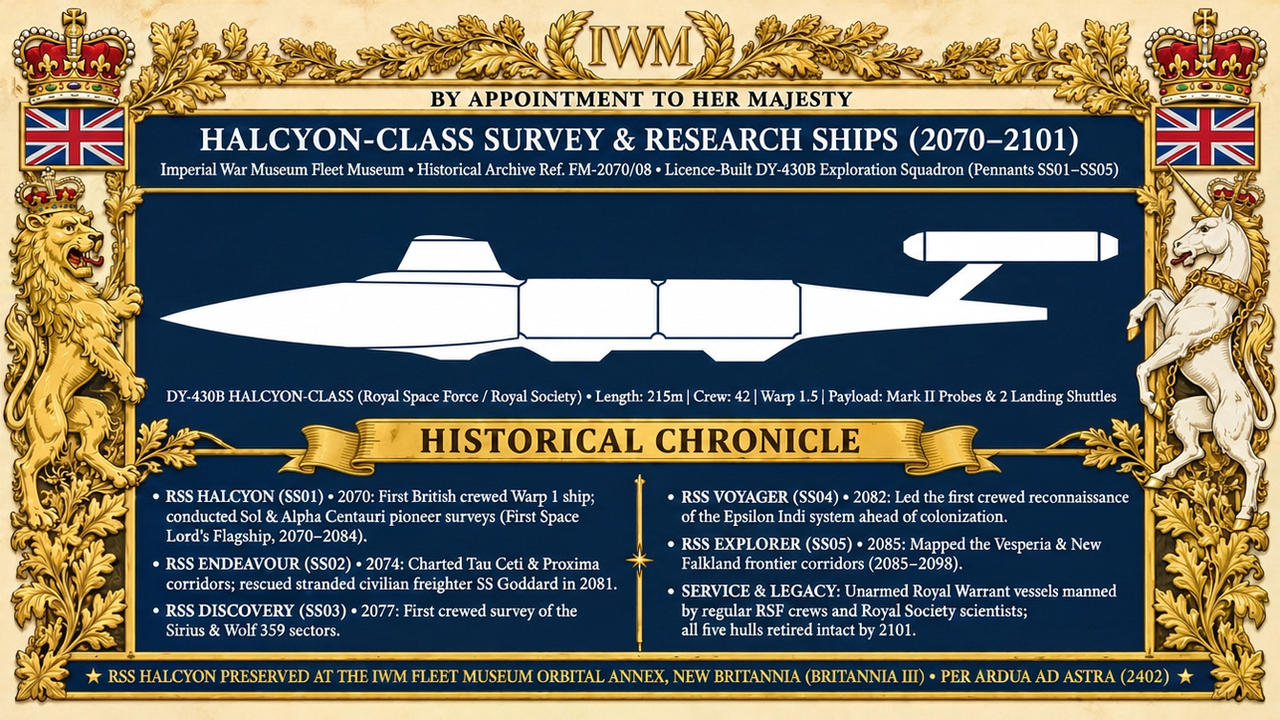
Imperial War Museum Fleet Museum Archive Ref. FM-2070/08 — Halcyon-Class (DY-430B) Survey & Research Ships (2070–2101)
Institution:
Imperial War Museum (IWM) Fleet Museum (Orbital Annex above New Britannia [Britannia III], HMNB Portsmouth & HMNB New Portsmouth)
Spacecraft Class: Halcyon-Class (DY-430B Licence-Built BAE Systems Space & Orbital / Rolls-Royce Subspace & Warp Systems) (5 Unarmed Royal Warrant Survey Vessels • Pennants SS01–SS05 • 215m Length • 42 Crew)
Operating Service: Owned by the Admiralty and manned directly by regular Royal Space Force (RSF) officers, ratings, and embarked Royal Society scientists (decades prior to the formation of the Royal Space Auxiliary for colonial logistics)
Propulsion & Top Speed: Rolls-Royce Subspace & Warp Systems Safe Inert-Fusing Micro-Warp Core (Warp 1.5 Maximum Sustained Speed)
Sensors, Probes & Landing Craft: Windowless armored submarine-style conning tower (internal sensor viewscreens), modular Royal Society astrometrics pods, single forward probe launcher deploying Mark II-A (Sensor), Mark II-B (Atmospheric), and Mark II-C (Survey) probes (evolved from the 2064–2070 Sol-system Mark I testbed), and a ventral shuttle bay housing two heat-shielded atmospheric landing shuttles
Motto: "Per Ardua ad Astra" (Through Adversity to the Stars)
Royal Research Ship (RSS) Warrant & Orbital Assembly (DY-400/430 → DY-430B):
Modeled directly on the United Kingdom's historic Royal Research Ship (RRS) tradition—where unarmed scientific exploration vessels hold a Sovereign's Royal Warrant—the five Halcyon-class pioneers operated under the RSS (Royal Research Ship) prefix (SS01–SS05). Following seven years of post-First Contact engineering, BAE Systems Space & Orbital and Rolls-Royce Subspace & Warp Systems acquired a manufacturing licence for the proven DY-400/DY-430 interplanetary hull, boosting modular sections into space from Woomera and Ascension Island for final assembly in Low Earth Orbit (LEO).
Squadron Roster (2070–2101):
• RSS Halcyon (SS01) • 2070: Britain's first crewed Warp 1 ship; served as First Space Lord's Flagship (2070–2084) and conducted pioneering Sol-perimeter and Alpha Centauri surveys (preserved intact at the IWM Fleet Museum Orbital Annex above New Britannia [Britannia III]).
• RSS Endeavour (SS02) • 2074: Charted the Tau Ceti and Proxima corridors; rescued the stranded civilian freighter SS Goddard in 2081.
• RSS Discovery (SS03) • 2077: Completed the first crewed astronomical and planetary surveys of the Sirius and Wolf 359 sectors.
• RSS Voyager (SS04) • 2082: Following Beagle-2's initial probe telemetry, led the first crewed reconnaissance and shuttle landing surveys of Epsilon Indi (Britannia III and Britannia IV / New Ireland), directly enabling the First-Wave Colony Arks.
• RSS Explorer (SS05) • 2085: Mapped the outer Vesperia and New Falkland frontier sectors (2085–2098).
Type 25 Vanguard-Class Warp 6 Battlecruisers (2155–2185)
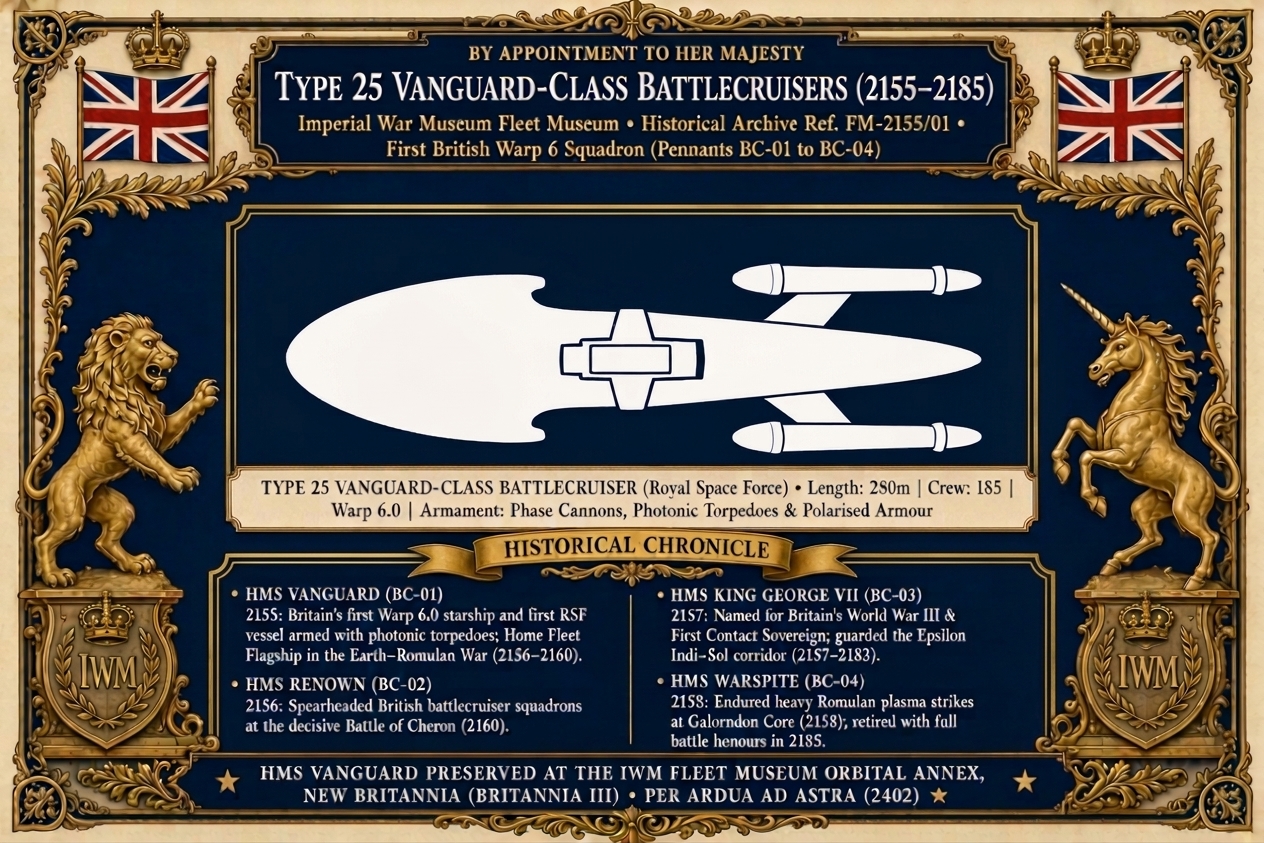
Imperial War Museum Fleet Museum Archive Ref. FM-2155/01 — Type 25 Vanguard-Class Warp 6 Battlecruisers (2155–2185)
Institution: Imperial War Museum (IWM) Fleet Museum (Orbital Annex above New Britannia [Britannia III], HMNB Portsmouth & HMNB New Portsmouth)
Spacecraft Class: Type 25 Vanguard-Class Battlecruiser (BAE Systems Space & Orbital / Rolls-Royce Subspace & Warp Systems) (4 Commissioned Battlecruisers • Pennants BC-01 to BC-04 • 280m Length • 185 Crew — Inaugurating the RSF battlecruiser lineage leading through the Type 50, Type 75, and Type 90 classes to 2402's Type 100 Lion-Class)
Propulsion & Top Speed: Rolls-Royce Subspace & Warp Systems Merlin-W6 Matter/Antimatter Core (Warp 6.0 Maximum Sustained Speed)
Armament & Protection: 6 Retractable Dual Phase-Cannon Turrets, Twin 2×2 Forward Photonic Torpedo Launchers (4 forward tubes — first RSF warship class armed with variable-yield photonic torpedoes, replacing older spatial torpedoes), 2 Aft Torpedo Tubes, and Polarised Duranium-Tritanium Hull Armour
Motto: "Per Ardua ad Astra" (Through Adversity to the Stars)
A Uniquely British Starfleet Silhouette (2155):
Designed in the early 2150s as a deliberate departure from United Earth Starfleet's detached-saucer NX-class layout, the Type 25 Vanguard-class established the classic Royal Space Force warship profile—merging a broad, rounded forward bow (housing twin 2×2 photonic torpedo launchers) continuously into a straight-flanked Royal Navy central engineering hull topped by an armored Admiralty bridge citadel and twin rear Rolls-Royce warp nacelles. Built at New Cornwall's Lunar Drydocks and L5 Orbital Yards, the four battlecruisers served across thirty years of front-line war and frontier patrol (2155–2185).
Squadron Roster (2155–2185):
• HMS Vanguard (BC-01) • 2155: Britain's first Warp 6.0 starship and first RSF vessel armed with photonic torpedoes; served as RSF Home Fleet Flagship during the Earth–Romulan War (2156–2160) (preserved intact at the IWM Fleet Museum Orbital Annex above New Britannia [Britannia III]).
• HMS Renown (BC-02) • 2156: Spearheaded British battlecruiser squadrons alongside Starfleet and Vulcan allies at the decisive Battle of Cheron (2160).
• HMS King George VII (BC-03) • 2157: Named in honour of Britain's World War III & First Contact Sovereign; guarded the Epsilon Indi–Sol corridor (2157–2183).
• HMS Warspite (BC-04) • 2158: Endured heavy Romulan plasma strikes at Galorndon Core (2158); retired with full battle honours in 2185 as second-generation Type 50 battlecruisers entered service.