Re: Star Trek: United Kingdom – The Last Bastion (AU/AI Lore | 1940–2402)
Posted: Sun Nov 22, 2026 10:01 am
Okay, something that is my own creation with the help of AI.
Imperial War Museum Fleet Museum Plate No. 31 — The Beagle Interstellar Probe Programme (2071–2115)
Institution: Imperial War Museum (IWM) Fleet Museum (HMNB Portsmouth & HMNB New Portsmouth)
Spacecraft Class: Beagle-Class Early Micro-Warp Exploration Probe (6 Built • 34m Length)
Propulsion & Top Speed: Early Safe Inert-Fusing Micro-Warp Core (Warp 1.8 Maximum Sustained Speed)
Sensors & Scientific Instruments: Long forward lattice truss boom isolating gravimetric scanners, atmospheric/biosignature spectrometers, magnetometer arrays, and high-gain subspace telemetry transceivers from rear warp-field interference
Cultural Payload: Royal Society Cultural & Scientific Archive (carrying peaceful greetings from King George VII, planetary science records, works of Shakespeare, Newton, and Darwin, and Elgar's Nimrod)
Motto: "Per Ardua ad Astra" (Through Adversity to the Stars)
Architecture & Historical Significance:
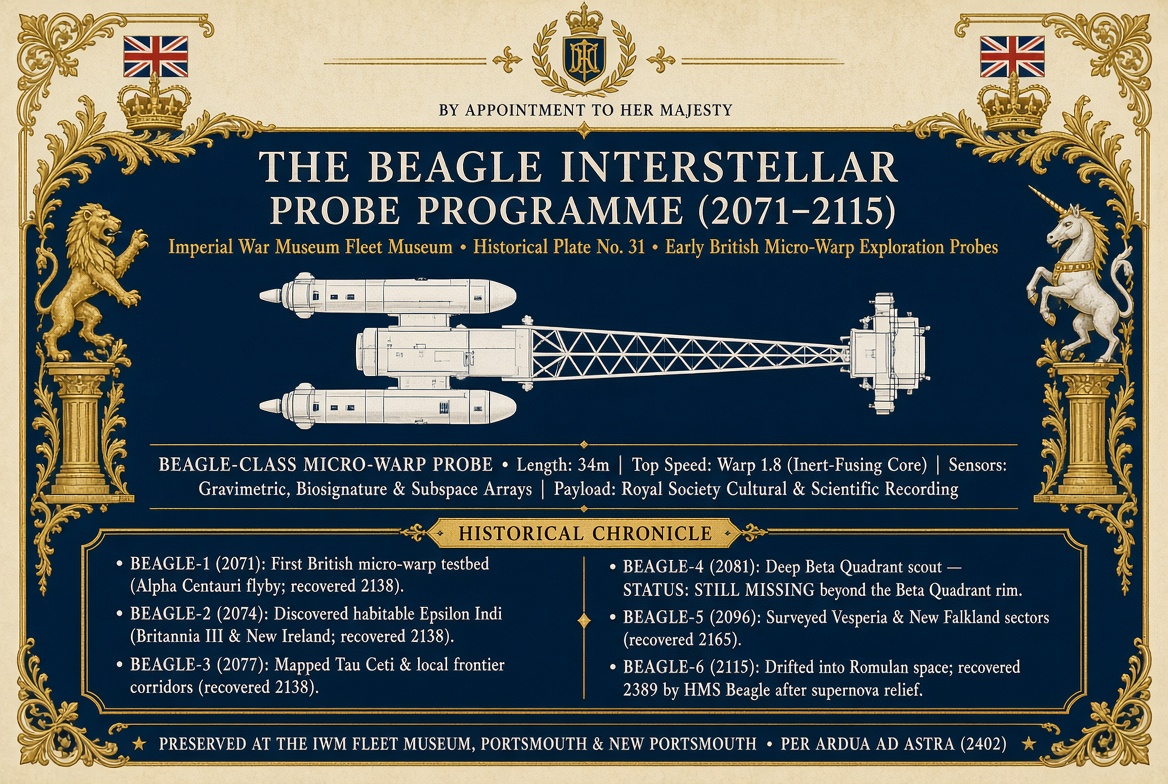
Launched in the aftermath of World War III and Britain's rapid orbital recovery, the six unmanned Beagle probes (Beagle-1 through Beagle-6) were the United Kingdom's first interstellar pathfinders. Designed around a compact central reactor disc, twin rear micro-warp nacelles, and an extended forward lattice truss boom that kept sensitive biosignature and gravimetric instruments clear of early warp-field radiation, each 34-metre probe carried a shielded Royal Society Cultural & Scientific Archive outward into uncharted space.
Mission Roster & Fates (2071–2389):
• Beagle-1 (Launched 2071): First British micro-warp interstellar testbed (Sol perimeter & Alpha Centauri flyby); retrieved in 2138 and preserved at the IWM Fleet Museum.
• Beagle-2 (Launched 2074): First detected the habitable Epsilon Indi system (Britannia III and Britannia IV / New Ireland), directly sparking British interstellar colonization; retrieved in 2138 alongside Beagle-1 and Beagle-3.
• Beagle-3 (Launched 2077): Charted the Tau Ceti and local Alpha Quadrant corridors; retrieved in 2138.
• Beagle-4 (Launched 2081): Deep-range Beta Quadrant scout; Status: Still Missing beyond the Beta Quadrant rim (remaining a priority search objective for RSF survey cruisers in 2402).
• Beagle-5 (Launched 2096): Surveyed the Vesperia and New Falkland frontier sectors; decommissioned and recovered in 2165.
• Beagle-6 (Launched 2115): Drifted across the future Romulan border during the early 22nd century. Following the 2387 Romulan supernova and Britain's major humanitarian relief effort for Romulan refugees, survey cruiser HMS Beagle received diplomatic clearance in 2389 to recover Beagle-6 from an abandoned Romulan border archive—reuniting it with Beagle-1, 2, 3, and 5 at the IWM Fleet Museum.
Imperial War Museum Fleet Museum Plate No. 31 — The Beagle Interstellar Probe Programme (2071–2115)
Institution: Imperial War Museum (IWM) Fleet Museum (HMNB Portsmouth & HMNB New Portsmouth)
Spacecraft Class: Beagle-Class Early Micro-Warp Exploration Probe (6 Built • 34m Length)
Propulsion & Top Speed: Early Safe Inert-Fusing Micro-Warp Core (Warp 1.8 Maximum Sustained Speed)
Sensors & Scientific Instruments: Long forward lattice truss boom isolating gravimetric scanners, atmospheric/biosignature spectrometers, magnetometer arrays, and high-gain subspace telemetry transceivers from rear warp-field interference
Cultural Payload: Royal Society Cultural & Scientific Archive (carrying peaceful greetings from King George VII, planetary science records, works of Shakespeare, Newton, and Darwin, and Elgar's Nimrod)
Motto: "Per Ardua ad Astra" (Through Adversity to the Stars)
Architecture & Historical Significance:
Launched in the aftermath of World War III and Britain's rapid orbital recovery, the six unmanned Beagle probes (Beagle-1 through Beagle-6) were the United Kingdom's first interstellar pathfinders. Designed around a compact central reactor disc, twin rear micro-warp nacelles, and an extended forward lattice truss boom that kept sensitive biosignature and gravimetric instruments clear of early warp-field radiation, each 34-metre probe carried a shielded Royal Society Cultural & Scientific Archive outward into uncharted space.
Mission Roster & Fates (2071–2389):
• Beagle-1 (Launched 2071): First British micro-warp interstellar testbed (Sol perimeter & Alpha Centauri flyby); retrieved in 2138 and preserved at the IWM Fleet Museum.
• Beagle-2 (Launched 2074): First detected the habitable Epsilon Indi system (Britannia III and Britannia IV / New Ireland), directly sparking British interstellar colonization; retrieved in 2138 alongside Beagle-1 and Beagle-3.
• Beagle-3 (Launched 2077): Charted the Tau Ceti and local Alpha Quadrant corridors; retrieved in 2138.
• Beagle-4 (Launched 2081): Deep-range Beta Quadrant scout; Status: Still Missing beyond the Beta Quadrant rim (remaining a priority search objective for RSF survey cruisers in 2402).
• Beagle-5 (Launched 2096): Surveyed the Vesperia and New Falkland frontier sectors; decommissioned and recovered in 2165.
• Beagle-6 (Launched 2115): Drifted across the future Romulan border during the early 22nd century. Following the 2387 Romulan supernova and Britain's major humanitarian relief effort for Romulan refugees, survey cruiser HMS Beagle received diplomatic clearance in 2389 to recover Beagle-6 from an abandoned Romulan border archive—reuniting it with Beagle-1, 2, 3, and 5 at the IWM Fleet Museum.